 Bora Bora Snorkeling
Manta Rays and Eagle Rays in Bora Bora
The lagoon's two great rays answer to different calendars and different waters: reef mantas hover year-round at a cleaning station on the eastern edge, and spotted eagle rays feed in schools over the southern sand flats in season-shifting numbers. Meeting the manta rays in Bora Bora - and their eagle-ray cousins - is the trip's headline; meeting both, as a surprising number of reviewers do, is the reason the manta-ground boats sell out first. This guide covers where each ray lives, how it behaves, the etiquette that keeps the encounter wild, and which boats reach which ground - the manta-route Bora Bora tour comparison prices them all.
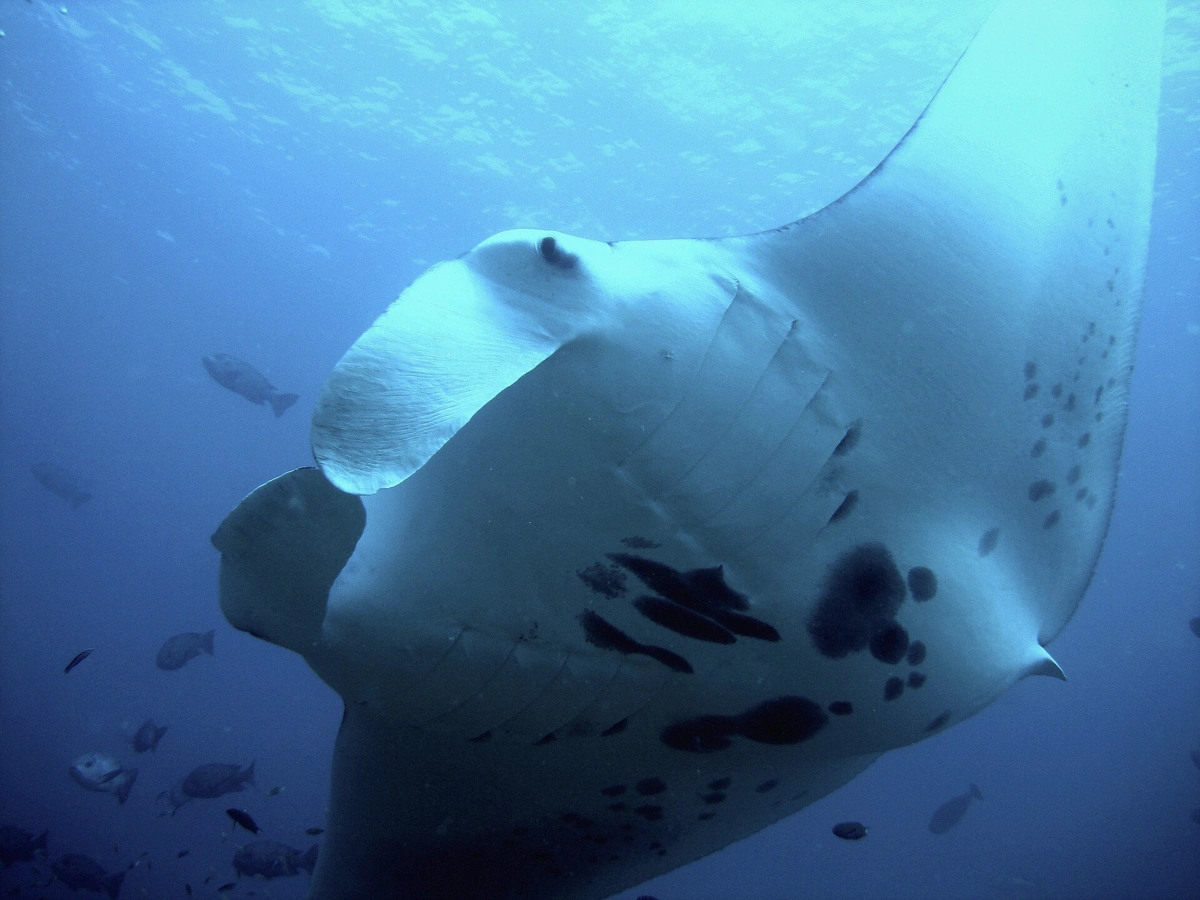
The headliner: a reef manta at the cleaning station - wings wider than the swimmer beneath is tall. Photo: Wikimedia Commons - see notes/commons-attribution.json. Illustrative photo: reef manta at a cleaning station in the Maldives.
Quick answer Where each ray lives, when the sightings peak, and the boats that run the manta ground first
Manta rays in Bora Bora live year-round at a cleaning station on the lagoon's eastern edge, hovering in current while small fish clean them - sightings run in pulses, and the guides who open there at first light (Reef Discovery) or set the stop by conditions (H2O) carry the best odds. Eagle rays feed over the southern sand flats in groups from a handful to fevers of 20+, lifting off the sand in formation when approached calmly. Neither species is ever promised; both are regulars in the review record.
Key takeaways
- The manta-first morning: Reef Discovery's signature run opens at the feeding ground before the fleet arrives.
- Reading the odds before booking: the all Bora Bora snorkel boats compared for ray seekers table puts review counts beside the routes.
The Manta: The Cleaning Station on the Eastern Edge
Reef manta rays live in the lagoon year-round, and the fixed point of their week is a cleaning station - a patch of reef on the eastern edge where small cleaner fish pick parasites from a manta's wings and gills while it hovers in a slow-motion current ride. The manta holds position over the station like a drone on station-keeping, wings rippling at the tips, mouth open to the plankton stream, and a swimmer floating at the surface watches the whole circuit at arm's-length depth. Reef Discovery's listing calls its opening stop the manta ray feeding ground - the same ground, named for the morning feed - and the crew's tactic is arrival: be there at first light, before the fleet, while the animals are working.
How manta sightings actually run
Pulses, not promises - and the review record says even the pulse-less days are close.
- The pulses: plankton conditions gather several mantas at once - one 2026 H2O review describes a mating ballet of eleven animals circling the boat
- The baseline: singles and pairs pass the grounds most mornings on the manta routes; the animals are residents, not migrants
- The close pass: mantas surface-feed on plankton lines and glide beneath swimmers - a 2025 Vavau reviewer watched one for over thirty minutes
- The honesty rule: no listing promises a manta - the ones that reach the ground sell odds, not certainties
Manta Behaviour: Reading the Wings
Mantas are filter feeders - among the ocean's largest brains on its gentlest diet - and their behaviour underwater is a legible language once the guide translates. A manta feeding swims long, straight lines with its cephalic fins (the two head-horns) flared to funnel water; a manta at the cleaning station barely moves, pitched upward while the cleaners work; and a manta that changes direction twice is telling the group its line, which is the cue to stop swimming and let it pass. The etiquette every manta-ground guide briefs: stay at the surface, never dive the animal, never block its line, and never touch - the slime coat that protects a manta rubs off under a human hand.
The three postures and what they mean
Read the wing and the morning writes itself.
- Line feeding - long straight glides with horn fins flared: the manta is working a plankton stream; drift alongside, never ahead
- Station hovering - near-stationary, pitched up, wings slowly beating: the cleaners are working; this is the minute-long encounter reviewers describe
- The turn-and-pass - the manta arcs back through the group's line: hold position, it will pass within metres, as it does in review after review
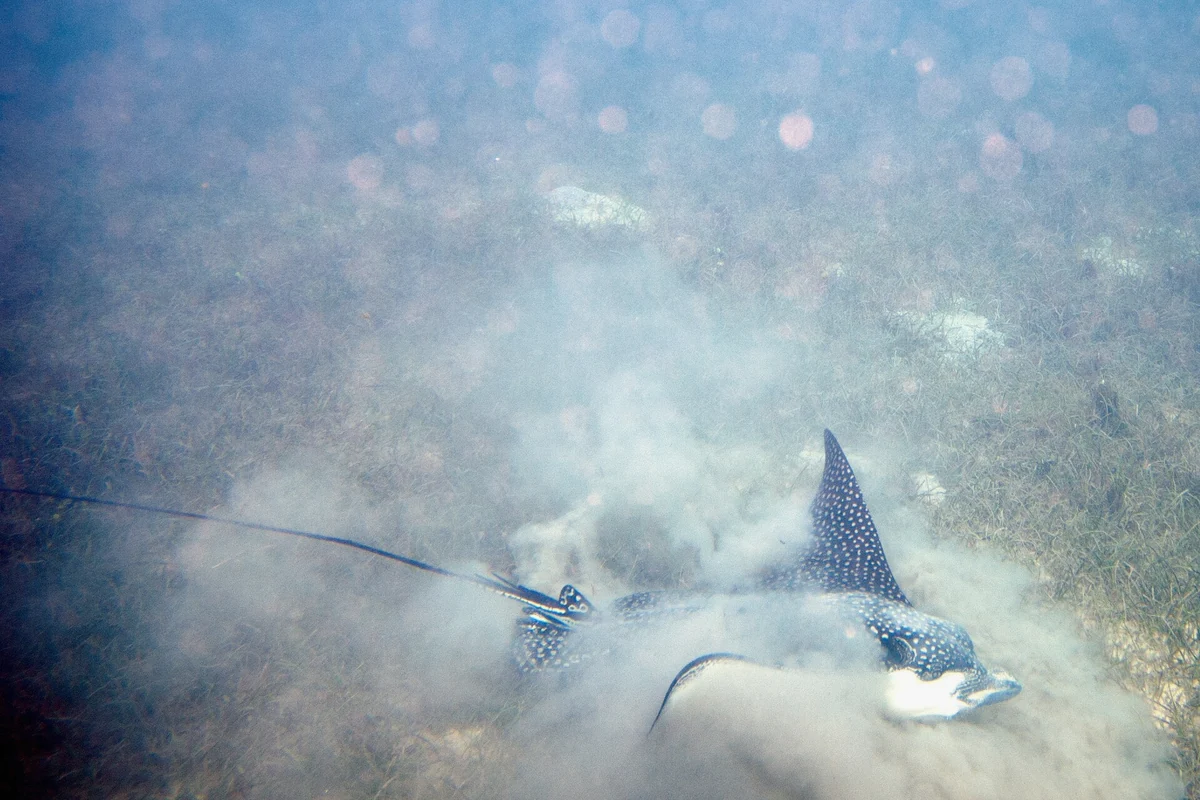
The southern flats' resident: a spotted eagle ray at cruise height - fast, shy, and worth every metre of the swim. Photo: Wikimedia Commons - see notes/commons-attribution.json. Illustrative photo: spotted eagle ray.
Eagle Rays: The Schools on the Southern Flats
Spotted eagle rays are the lagoon's speed element - white-spotted backs, whip tails, and a flight pattern that earns the word. They feed nose-down over the southern sand flats in groups that run from a half-dozen to the fever of 20+ eagle rays one H2O reviewer counted lifting off in formation. Unlike the hovering mantas, eagle rays are shy and mobile: the group approaches, feeds, lifts, and glides a hundred metres to feed again.
The crews that work the flats - H2O names its run the Eagle Ray playground, Reef Discovery carries the conditional stop - read the water for pale shadows and set swimmers up-current of the school's line, which turns the lift-off into a flypast rather than a chase.
How to be there when they lift
Eagle-ray encounters are earned by stillness.
- Watch for the shadows: feeding rays print dark shapes on pale sand long before they surface
- Stop swimming when the group lifts - the school's arc usually returns across the same line
- Keep vertical: standing swimmers read as poles; swimming swimmers read as predators
- Let the guide set the drift: the up-current entry is the difference between a flypast and an empty flat
The Third Ray: Stingrays, the Ground Floor
The manta and the eagle ray share the lagoon with their ground-dwelling cousin, and most itineraries meet all three in one morning: stingrays on the knee-deep sandbars, eagle rays over the flats, mantas at the edge. The stingray is the encounter's ground floor - waist-deep, arm's-length, the ray that swims to you - and the shark-and-ray guide covers its rules in full. The three-ray day is a genuine pattern: Reef Discovery's reviews describe mantas at the station, a seahorse in the garden, eagle rays on the flats and stingrays at the sandbar, in a single signature morning.
Three rays, one table
The cast, the water and the odds - figures from the operators' listings and reviews, September 2026.
| Ray | Water | Behaviour | Best odds |
|---|---|---|---|
| Reef manta | 4-8 m at the eastern edge | Hovering, line-feeding, surface passes | Reef Discovery opening stop; H2O conditional stop |
| Spotted eagle ray | 2-5 m over southern flats | Schooling, feeding nose-down, fast lift-offs | H2O's flats run; Reef Discovery |
| Stingray | Knee-deep sandbars | Resident, curious, approaches swimmers | Every listing in the comparison |
Timing the Rays: Seasons, Hours and the Seasonal Extras
The rays keep overlapping calendars. Mantas are lagoon residents - year-round at the station, with sighting pulses that follow plankton rather than months. Eagle rays are year-round residents too, in shifting numbers; the big schools run when the flats are quietest, which the crews time against the fleet.
And the wet-season water brings the reef's general bustle up - fish activity peaks in the warm months. The seasonal extras ride the edges of the same calendar: dolphins pass the boats in transit (reviewers log them across all seasons), and humpback whales work the passes roughly August to November - the whale boats' season, not the snorkel boats', but a breach from a lagoon boat is a recorded event.
The ray calendar, compressed
When to come for which animal.
- Mantas: year-round; pulses unpredictable; morning grounds carry the best odds on the two manta routes
- Eagle rays: year-round; schools largest on quiet flats - shoulder months and early boats
- Stingrays: every day, every season - the constant
- Dolphins: transit sightings across the year; whales: August-November at the passes, dedicated boats only
The Cleaning Station Explained: Why Mantas Hold Still
The eastern cleaning station works because three things meet there: a reef outcrop where cleaner fish can set up shop, a current edge that brings plankton and oxygen, and deep water close by for the mantas to approach along. A manta that pulls into the station slows to a near-stop, pitched upward, wings beating just enough to hold position while small wrasse work its gills, its wing edges, the parasites a highway swimmer accumulates. The session can run minutes.
For the swimmer at the surface, the manta is not passing - it is parked, one wing-beat below, close enough to watch the cleaners commute. That is why the good boats open at first light: the station serves a queue, and the first swimmers get the resident on her best behaviour.
Station manners, compressed
The etiquette that keeps the appointment running.
- Float at the surface over the station - the manta needs its vertical space below
- Never dive toward the animal; the upward watch is the encounter
- Keep the line: enter up-current and let the station come to you
- No touch, no flash-chasing, no fins over the reef - the station's clients spook as one
Seasonal extras: dolphins, whales and the pelagic edge
The rays are the lagoon's residents; its visitors ride the calendar. Spinner dolphins work the channels in transit and surface alongside moving boats often enough that reviews treat a bow-riding escort as a bonus, not a promise. Humpback whales pass the Society Islands in the austral spring and summer - roughly August to November - and while the swim boats stay inside the reef, dedicated whale boats work the passes in season, and a blow or a breach from a lagoon boat is a recorded event on both manta routes.
Pelagic visitors beyond that - the oceanic sharks, the big schools - live outside the barrier, in the water the snorkel fleet never crosses. The lagoon's promise is precise: its residents, reliably; its visitors, as gifts.
Photographing rays: settings and manners
Ray photography is a manners problem before it is a settings problem, because every posture in the behaviour section has a shot that only works from the swimmer's place in the circle. The settings are simple: shutter priority around 1/500 for cruising mantas and eagle rays, ISO auto with a ceiling your camera handles cleanly, and the camera a hand's length under the surface where the light lives - half-in half-out shots come from the same position. The manners are harder: shoot the animal's line, never across it; let the guide position the group rather than swimming the flanks; and put the camera down for one full stop per swim.
The reviews' best ray photos come from travellers who watched first and lifted the camera second - the manta that trusts the circle swims under the lens on her own.
The Animal by the Numbers: Wings, Weight and Speed
The reef manta's figures explain the encounter better than any adjective. A reef manta spans three to four metres - the wings that glide past a swimmer are wider than a car is long - yet the animal weighs in around a few hundred kilograms on a diet of plankton strained through its gill plates, which is why the encounter is grace rather than threat: nothing that size wants you, only the water you are floating in. Cruising speed runs a few kilometres an hour at feeding pace, which is exactly swimmer speed; a manta that wants to leave simply opens the throttle and vanishes, and the ones that stay are choosing to.
Eagle rays run the opposite package: a metre of spotted disc, a whip tail twice that, and a cruising pace that makes the stingray look sedentary. The numbers behind the cleaning station explain the meeting; the animal's own figures explain the memory.
The figures, side by side
Reef manta versus spotted eagle ray - the two animals a manta route exists for.
| Trait | Reef manta | Spotted eagle ray |
|---|---|---|
| Wingspan | 3-4 m | About 1 m disc, 2.5 m tail |
| Diet | Plankton, filter-fed | Shellfish, dug from sand |
| Speed at encounter | Near-still at the station | Fast; lifts and glides |
| Temperament with swimmers | Curious, holds position | Shy, keeps distance |
| Where the routes meet them | Eastern cleaning station | Southern sandy flats |
The tide, the cleaners and the hour
The station's timetable is tidal. Cleaner fish work the reef outcrop on the current the tide delivers, and the mantas time their visits to that service window - which is why the guides' tide tables matter more than their fish-finders, and why the same ground can read empty at the wrong hour and host three animals at the right one. The pattern the crews work: the morning push brings the cleanest water and the most reliable station traffic, the slack hours thin out, and the drop-offs between mantas run in days rather than hours.
A traveller booking a manta-first route is really booking the crew's tide table - and the reason Reef Discovery's signature morning opens there is arithmetic, not romance.
Ray Safety, Briefly: The Manta's Tail Question
The manta's long tail raises the one question every guide hears, and the answer is anatomy: the reef manta is tailless of sting - it carries no barb, no venom, none of the defensive hardware a stingray keeps at its tail root. Mantas are filter feeders whose only defence is size, and their historic nickname - devil ray - came from the cephalic fins' horned silhouette, not from behaviour. The eagle ray, by contrast, is a true stingray cousin with a barb near the whip tail's base, and it keeps that barb for the same defensive purpose.
Practical translation: the manta is the one animal in the lagoon you can float above with zero tail management, the eagle ray is watched at its own chosen distance, and the sandbar's stingrays take the standard shuffled-feet respect. The species guide carries the full encounter rules.
Fevers, trains and flotillas: the nouns that work
The lagoon's ray gatherings have earned their collective nouns, and the reviews use them accurately. A fever of eagle rays - the school lifting off the flats in formation - appears across years of H2O and Reef Discovery reviews, counts of twenty and more. A train of mantas describes the feeding line the eastern channel produces in pulses, animals spaced along a plankton street.
And a flotilla - the boats' own word - is what the morning looks like from the motu: hulls rafted at the sandbar while their swimmers share the shallows. The nouns are not decoration; each describes a behaviour with a bookable hour attached.
Eagle-Ray Hours: When the Flats Fill
The eagle-ray flats keep shorter hours than the guides' patience, and the reviews point to the same window: the first two hours after sunrise, when the flats are quiet, the light falls soft across the sand, and the feeding schools print their shadows longest. By late morning the boats have found them and the schools lift and move on - visible, but at distance. The crews that treat the flats as a destination rather than a transit put their boats there for that first window, and the traveller choosing between half-days should read the departure times as carefully as the routes: an early slot on the H2O small-boat or the Reef Discovery signature run buys the flats at their best hour, and the season guide's morning rule applies double for rays.
Mantas and Eagle Rays: FAQ
Where can you see manta rays in Bora Bora?
At the cleaning station on the lagoon's eastern edge, where reef mantas hover in current year-round. Reef Discovery opens there first thing each morning; H2O sets the stop by conditions. The behaviour and etiquette are in the manta section.
When do eagle rays appear in Bora Bora?
Year-round over the southern sand flats, feeding in groups from a handful to schools of 20 and more. The big-school days track the quiet flats - shoulder months and the first boats of the morning - and the crews that name the stop read the water for the shadows before setting the drift.
Do you touch the rays on a Bora Bora snorkel tour?
No - and the no is doubled for mantas, whose protective slime coat rubs off under a hand. Stingrays are met with closed hands and still feet, mantas are watched from the surface, and eagle rays are far too fast to touch anyway. The guides brief all of it before the first swim.
Are manta rays in Bora Bora year-round?
Yes - the eastern cleaning station holds resident mantas all year, with sightings running in plankton-driven pulses rather than seasons. One 2026 review describes eleven animals in a mating ballet; the honest floor is singles and pairs on most mornings that the manta routes run.
What is the difference between manta rays and eagle rays?
Size, diet and posture: mantas are six-metre filter feeders that hover and glide with their mouths open; eagle rays are metre-scale hunters with white-spotted backs, whip tails and a nose-down feeding style over sand. One hovers at the cleaning station, the other flies over the flats - the table above sorts the water they live in.
Can you see rays without a tour in Bora Bora?
Stingrays, yes - house-reef shallows get dawn patrols, and the sandbar stops are the tour version of the same animals. Mantas and eagle rays, effectively no: the cleaning station and the flats sit beyond swimming distance of every deck, reachable only by boat.